


Article Summary
Udemy instructor Steve Ballinger shares how professionals can keep up with AI without feeling overwhelmed through practical learning, ongoing support, and his new community, Practical AI Results.
Courses are a great way to learn AI, but with tools changing so fast, many people want support once the course ends. That’s the idea behind Udemy Communities: instructor-led spaces where, depending on the community, you can bring your questions to an instructor you trust, get hands-on practice, and apply what you learn to your own work, alongside others with similar goals.
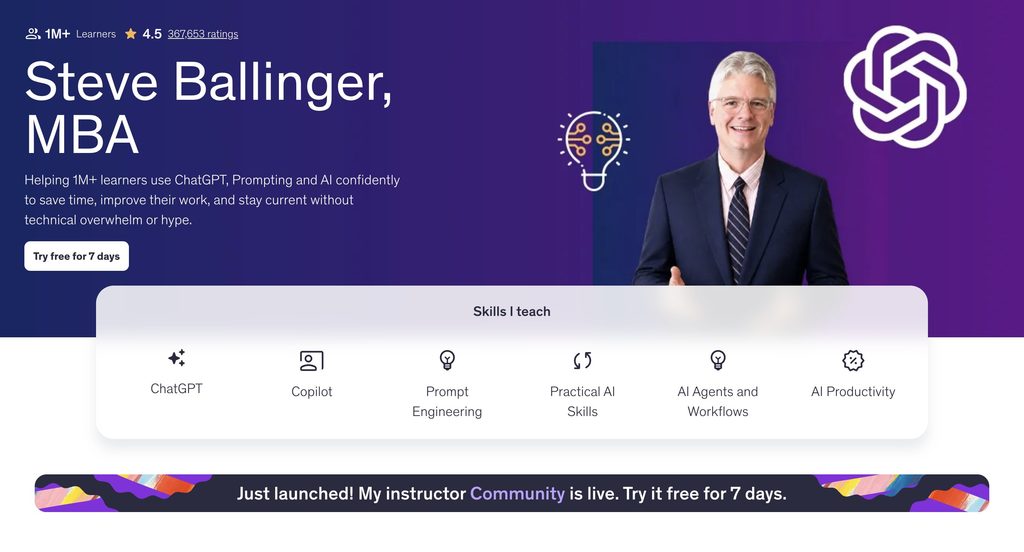
Steve Ballinger, who teaches ChatGPT, prompt engineering, Copilot and AI agents on Udemy, has just launched his community, Practical AI Results. We caught up with him to hear what’s behind it, who it’s for, and how he keeps up with AI himself.
1. You’ve built one of the biggest AI audiences on Udemy. Before we get into your new community, tell us a bit about your own AI journey. How did you end up becoming someone so many professionals turn to for AI skills?
Before AI, I had built a large audience on Udemy through courses in areas such as investing and leadership. When ChatGPT became available to the public, I signed up one evening at about 8 p.m. to see whether it could help with my business. I expected to spend a few minutes exploring it. Next thing I knew it was 3 a.m.
I was fascinated by what AI could do, but also by its limits, ethical questions, and wider effects on society. That curiosity led me to create my flagship course, ChatGPT: Complete ChatGPT Course for Work (Ethically!). Since then, I’ve created courses in prompt engineering, Copilot, AI Fundamentals, AI Ethics, AI Security, AI Agents and more, with a focus on helping people use AI in their professional lives. I feel so blessed that over 1.2 million learners from over 220 countries have taken my Udemy courses.
2. AI seems to move faster every month. What’s the biggest challenge you see professionals facing when they try to keep up, and how do you approach it yourself?
The biggest challenge is the feeling that AI is changing so quickly that you might miss something genuinely useful. Professionals have to sort through a lot of noise and hype to find what can actually help them. I’ve experienced that pace firsthand: I’ve created a lesson in the morning and needed to update it later that day.
I try to keep my focus on a smaller number of tools and on skills that carry across platforms, such as writing effective prompts and directing AI agents. You don’t have to learn everything to make useful progress.
3. Which brings us to your community, Practical AI Results. What made you want to create it, and who is it for?
I created Practical AI Results because learning about AI can feel overwhelming, and people need practical ways to turn it into useful results. The community is designed especially for nontechnical aspects of using AI at work so everyone can benefit, though members also enjoy sharing ways they use it in their personal lives.
The name reflects the goal: practical ideas, resources, and support that help members get results. I see the community as a place for ongoing conversation and useful materials alongside the more structured learning in my Udemy courses.
4. Let’s get specific. What does being part of Practical AI Results actually look like, and what can someone expect from your community?
Members can ask questions, share what they’re trying, and learn from my responses and from one another. The community also includes resources members can use when they need them: Prompt Packs, Workflow Kits, Agent Blueprints, Skill Cards, checklists, templates, and short videos.
I add new resources each week, and members can suggest what they’d like me to create. I also post a weekly recap, so people can catch up without needing to check in every day. The aim is to make participation approachable and useful, even if someone has only a few minutes.
5. A community is a chance for members to learn with you directly. What kinds of questions or challenges do you hope members will bring, and how do you like to work through them together?
Members can bring the challenges and questions they’re facing in real work: how to get a better result from AI without repeatedly reworking a prompt, whether an AI agent could help with a task, or how to think through pressure to use AI more. I want us to look at those questions honestly and practically.
Sometimes AI can help; sometimes it isn’t the right tool. Members should be able to explore both possibilities without feeling that every problem needs an AI solution.
6. What would you like members to walk away with, and what does progress look like in Practical AI Results?
I’d like members to leave with something they can use: a better prompt, a workflow they can adapt, a clearer understanding of an AI tool, or more confidence deciding when AI is useful.
Progress can happen at whatever pace fits someone’s work and life. A member might spend a few minutes in the community one week, download a resource, and try one small idea. There’s no requirement to keep up with every update or take on a major challenge. The community is designed to be enjoyable and easy and certainly not overwhelming. Already too much overwhelm in our lives.
7. Finally, for someone who feels overwhelmed trying to keep up with AI on their own and is curious about a community like yours, what would you say to them?
If AI feels overwhelming, frustrating, or harder to use than you expected, Practical AI Results is designed specifically to make it much more manageable and effective.
You can explore practical resources, ask questions, and participate at a pace that works for you. Udemy offers a seven-day free trial for communities, so you can see whether it’s a good fit.
If you prefer a structured course, my Udemy courses cover topics including ChatGPT for work, prompt engineering, Copilot, and AI agents. The community can be an optional add-on if you so choose. My goal is simple: I just want to help people and I’d be glad to help you find a starting point that fits what you want to learn.
If you’d like to learn more about Steve’s community, take a look at Practical AI Results.